Global web icon
oregonstate.education
https://open.oregonstate.education/anatomy2e/chapt…
6.4 Bone Formation and Development – Anatomy & Physiology 2e
During intramembranous ossification, compact and spongy bone develops directly from sheets of mesenchymal (undifferentiated) connective tissue. The flat bones of the face, most of the cranial bones, and the clavicles (collarbones) are formed via intramembranous ossification.
Global web icon
nih.gov
https://pmc.ncbi.nlm.nih.gov/articles/PMC7986209/
Making and shaping endochondral and intramembranous bones - PMC
The precise positioning, size, and shape of skeletal elements is therefore critical for their function. During embryonic development, bone forms by endochondral or intramembranous ossification and can arise from the paraxial and lateral plate mesoderm or neural crest.
Global web icon
anatomynote.com
https://anatomynote.com/intramembranous-ossificati…
Intramembranous Ossification Diagram: Understanding Bone Formation ...
This medical image illustrates the four steps of intramembranous ossification, from the clustering of mesenchymal cells to the formation of compact bone and red marrow, with detailed labels highlighting cellular and structural changes.
Global web icon
orthobullets.com
https://www.orthobullets.com/basic-science/9007/in…
Intramembranous Bone Formation - Basic Science - Orthobullets
beta-catenin enters cells and induces cells to form osteoblasts which then proceed with intramembranous bone formation important transcription factors include CBFA1 (also know as Runx2) and osterix (OSX) sclerostin, created by the SOST gene, decreases bone mass by inhibiting the Wnt pathway
Global web icon
biologyinsights.com
https://biologyinsights.com/what-is-intramembranou…
What Is Intramembranous Ossification? - Biology Insights
Intramembranous ossification is a primary method by which bone tissue forms within the body. This process involves the direct development of bone from sheets of mesenchymal connective tissue, an embryonic tissue.
Global web icon
pressbooks.pub
https://ubalt.pressbooks.pub/introductiontohumanbi…
6.4 Bone Formation and Development – Introduction to Human Biology
During intramembranous ossification, compact and spongy bone develops directly from sheets of mesenchymal (undifferentiated) connective tissue. The flat bones of the face, most of the cranial (skull) bones, and the clavicles (collarbones) are formed via intramembranous ossification.
Global web icon
britannica.com
https://www.britannica.com/science/bone-anatomy/Ty…
Bone - Osteogenesis, Ossification, Intramembranous | Britannica
A few bones (such as the clavicle and the calvarium) develop within a condensed region of fibrous tissue without a cartilaginous intermediate (membrane bone formation).

Global web icon
hawaii.edu
https://pressbooks-dev.oer.hawaii.edu/anatomyandph…
Bone Formation and Development – Anatomy & Physiology
During intramembranous ossification, compact and spongy bone develops directly from sheets of mesenchymal (undifferentiated) connective tissue. The flat bones of the face, most of the cranial bones, and the clavicles (collarbones) are formed via intramembranous ossification.
Global web icon
teachmephysiology.com
https://teachmephysiology.com/histology/tissue-str…
Bone Ossification - Process - Histology - TeachMePhysiology
Intramembranous ossification is a process that forms flat bones such as the skull and the clavicle, through the remodelling of mesenchymal connective tissue. Intramembranous ossification begins in-utero and continues into adolescence.
Global web icon
cancer.gov
https://training.seer.cancer.gov/anatomy/skeletal/…
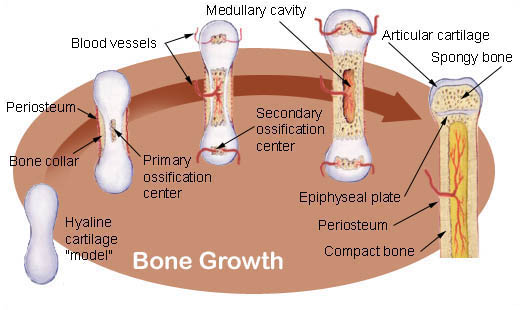
Bone Development & Growth - SEER Training
Bone Development & Growth The terms osteogenesis and ossification are often used synonymously to indicate the process of bone formation. Parts of the skeleton form during the first few weeks after conception. By the end of the eighth week after conception, the skeletal pattern is formed in cartilage and connective tissue membranes and ossification begins. Bone development continues throughout ...