What does Transversal Mean in Geometry? In geometry, a transversal is a line, ray, or line segment that intersects other lines, rays, or line segments on a plane at different intersecting points.
In geometry, a transversal is a line that passes through two lines in the same plane at two distinct points. Transversals play a role in establishing whether two or more other lines in the Euclidean plane are parallel.
A transversal is a line that intersects at least two other lines. When parallel lines are crossed by a transversal many angles are the same, as in this example: See Parallel Lines and Pairs of Angles to learn more. Lots of angles match up here!
Transversals play an important role in establishing whether two or more other lines in the Euclidean plane are parallel. In this article, you will learn the definition of transversal line, angles made by the transversal with parallel and non-parallel lines with an example. Also, learn more concepts of geometry here. Table of Contents:
What is a Transversal Line? A transversal line in geometry is a straight line that intersects two or more lines. When a transversal line intersects two lines, it creates pairs of corresponding angles, alternate interior angles, and alternate exterior angles.
A transversal is a line that passes through two lines in the same plane at two distinct points. Transversals play a role in establishing whether two other lines in the Euclidean plane are parallel.
A Transversal Line is a line that crosses at least two lines (Parallel Lines) and intersects with them. Find Problems on Transversal Lines with Solutions for a better understanding of the concept.
In the field of geometry, a transversal line is a line that travels through two other lines within the same plane at two different points. In the Euclidean plane, transversals are an essential component in the process of producing parallelism between two or more additional straight lines.
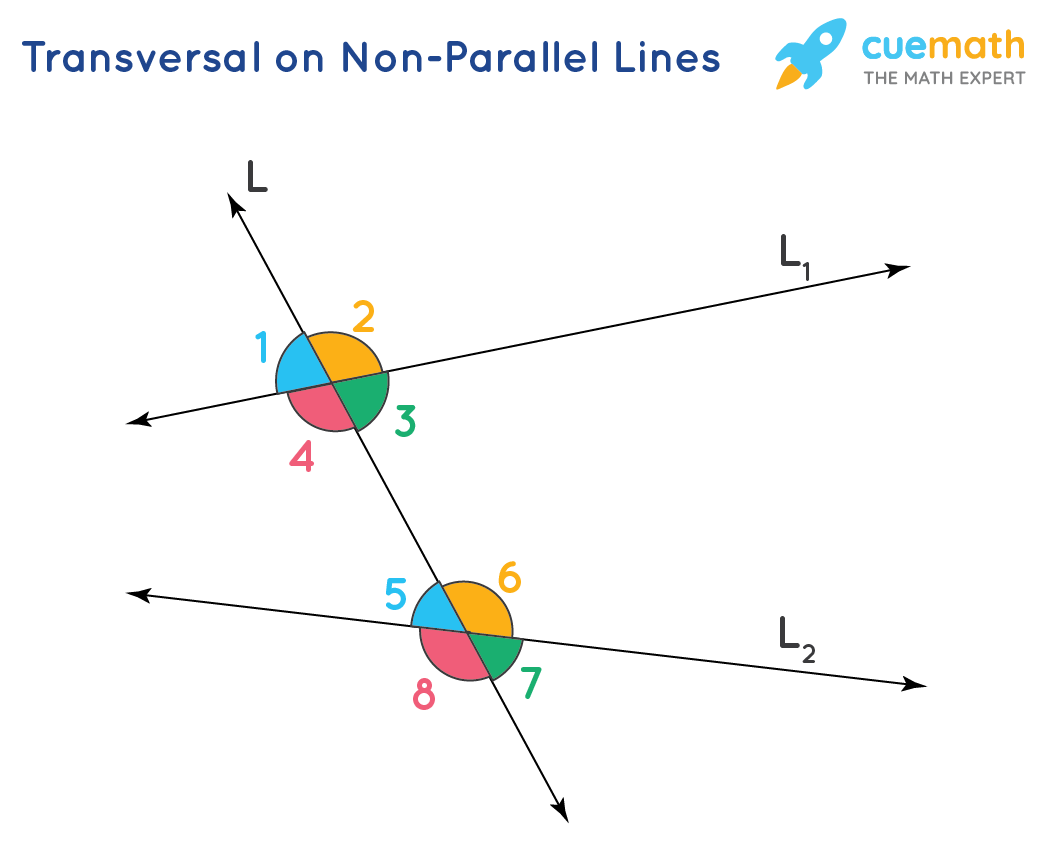 What does Transversal Mean in Geometry? In geometry, a transversal is a line, ray, or line segment that intersects other lines, rays, or line segments on a plane at different intersecting points.