Global web icon
verywellhealth.com
https://www.verywellhealth.com/intestines-8643603
The Intestines: Labeled Diagram, Function, Conditions
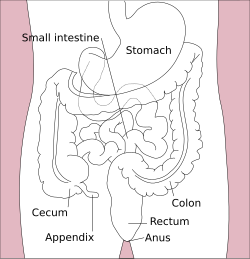
The large and small intestines are part of the gastrointestinal (GI) tract, the passage running from the mouth to the anus. The intestines run from the end of the stomach to the anus. Their primary function is to absorb nutrients and vitamins.
Global web icon
wikipedia.org
https://en.wikipedia.org/wiki/Gastrointestinal_tra…
Gastrointestinal tract - Wikipedia
In human anatomy, the intestine (bowel or gut; Greek: éntera) is the segment of the gastrointestinal tract extending from the pyloric sphincter of the stomach to the anus and as in other mammals, consists of two segments: the small intestine and the large intestine.
Global web icon
medicalnewstoday.com
https://www.medicalnewstoday.com/articles/intestin…
How do the intestines work? - Medical News Today
Learn more about the parts, dimensions, and functions of the intestines. We also describe related health issues, their treatments, and warning signs.
Global web icon
innerbody.com
https://www.innerbody.com/image/dige08.html
The Intestines: Anatomy and 3D Illustrations - Innerbody
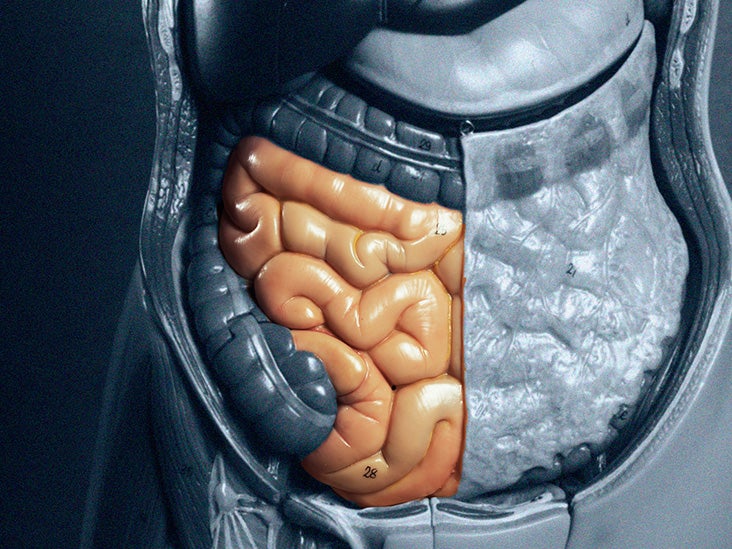
The intestines are vital organs in the gastrointestinal tract of our digestive system. Their functions are to digest food and to enable the nutrients released from that food to enter into the bloodstream. Our intestines consist of two major subdivisions: the small intestine and the large intestine.
Global web icon
clevelandclinic.org
https://my.clevelandclinic.org/health/body/22134-c…
Large Intestine & Colon: Function, Anatomy & Location
What is the large intestine? Your large intestine is part of your digestive system. It turns food waste into solid poop (stool) and drives the pooping process. Issues with your large intestine can lead to everyday conditions like constipation or diarrhea. They can also lead to more serious conditions like colorectal cancer.
Global web icon
usz.ch
https://www.usz.ch/en/organs/intestine/
Intestine: structure, function, diseases – USZ
It processes the food we eat every day and absorbs the nutrients. It also ensures that harmful substances are excreted. The intestines are home to billions of beneficial bacteria. An intact intestinal flora is therefore particularly important for our digestion and for a strong immune system.
Global web icon
britannica.com
https://www.britannica.com/science/intestine
Intestine | Digestion, Absorption, Peristalsis | Britannica
The intestine is the site of most chemical digestive processes and the place where digested food materials are either absorbed for use by the body or collected into feces for elimination. The anterior part of the intestine, which is linked to the stomach, is called the small intestine.
Global web icon
mednewspedia.com
https://mednewspedia.com/where-are-your-intestines…
Where Are Your Intestines Located? Understanding the Small and Large ...
To demystify the subject, we must explore the intestines anatomy in full, diving into the exact placement, structure, and function of both the small and large intestine. Along the way, we’ll answer common questions like where is your small intestine, where is your bowel, and where is feces stored.
Global web icon
healthencyclopedia.org
https://healthencyclopedia.org/intestine/
Intestine
The small and large intestines differ in several aspects, including their structure, function, and the types of nutrients they absorb. The small intestine is longer, has a more complex structure with villi and microvilli, and is responsible for the majority of nutrient absorption.
Global web icon
biologyinsights.com
https://biologyinsights.com/what-are-bowels-and-wh…
What Are Bowels and What Is Their Function? - Biology Insights
The bowels, also known as the intestines, are a long, tube-shaped organ located in the abdomen. They play a central role in the digestive system, completing the process of digestion and preparing waste for elimination from the body.